LAW 11 ? OFF-SIDE AND ON-SIDE IN GENERAL PLAY

第11条 一般のプレーにおけるオフサイドとオンサイド

DEFINITION

At the start of a game all players are on-side. As the match progresses players may find themselves in an off-side position. Such players are then liable to be penalized until they become on-side again.

In general play a player is off-side if the player is in front of a team-mate who is carrying the ball, or in front of a team-mate who last played the ball.

Off-side means that a player is temporarily out of the game. Such players are liable to be penalized if they take part in the game.

In general play, a player can be put on-side either by an action of a team-mate or by an action of an opponent. However, the off-side player cannot be put onside if the off-side player interferes with play; or moves forward, towards the ball, or fails to move 10 metres away from the place where the ball lands.

定 義

試合の開始時にはプレーヤーはすべてオンサイドである。試合が進むにつれて、オフサイドの位置となることがある。そのようなプレーヤーは再びオンサイドとなるまでに、競技に参加すれば反則が適用される。

一般のプレーでは、プレーヤーがボールを持っているかまたはプレーした場合に、そのプレーヤーの前方にいる味方のプレーヤーはオフサイドである。

オフサイドとは、プレーヤーが一時的にプレーできないことを意味し、かつ競技に参加すれば反則が適用される位置にあることをいう。

一般のプレーでは、味方の行為か相手側の行為かのいずれかによりオンサイドとなりうる。しかし、もしそのオフサイドプレーヤーがプレーを妨げたり、前方に、ボールの方へ動いたり、またはキックされたボールの着地点から10 メートル後方へ離れなければ、オンサイドとはならない。

11.1 OFF-SIDE IN GENERAL PLAY

(a) A player who is in an off-side position is liable to penalty only if the player does one of three things: Interferes with play or, Moves forward, towards the ball or Fails to comply with the 10-Metre Law (Law 11.4).

A player who is in an off-side position is not automatically penalised.

A player who receives an intentional throw-forward is not off-side.

A player can be off-side in the in-goal.

(b) Off-side and interfering with play. A player who is off-side must not take part in the game. This means the player must not play the ball or obstruct an opponent.

(c) Off-side and moving forward. When a team-mate of an off-side player has kicked ahead, the off-side player must not move towards opponents who are waiting to play the ball, or move towards the place where the ball lands, until the player has been put on-side.

1 一般のプレーにおけるオフサイド

(a)オフサイドの位置にいるプレーヤーが、反則となるのは次の3つのうちのいずれかを犯した場合のみである。

・プレーを妨げる、あるいは

・前方にボールの方へ動く、あるいは、

・本条4の「10 メートル規則」を守らない

プレーヤーは、オフサイドの位置にいるからといって自動的に反則となるのではない。

故意でないスローフォワードを受けとった場合、そのプレーヤーはオフサイドではない。

プレーヤーはインゴールでもオフサイドとなる。

(b)プレーの妨害

オフサイドの位置にいるプレーヤーは競技に参加してはならない。すなわち、ボールをプレーしたり、相手側を妨害してはならない。

(c)前方へ動くこと

味方のプレーヤーが前方へキックしたとき、前方にいるオフサイドプレーヤーは、オンサイドになるまでは、ボールをプレーしようと待っている相手側のプレーヤーまたはボールが地面に着く地点に近づいてはならない。

11.2 BEING PUT ON-SIDE BY THE ACTION OF A TEAM-MATE

In general play, there are four ways by which an off-side player can be put on-side by actions of that player or of team-mates;

(a) Action by the player. When the off-side player runs behind the team-mate who last kicked, touched or carried the ball, the player is put on-side.

(b) Action by the ball-carrier. When a team-mate carrying the ball runs in front of the off-side player, that player is put on-side.

(c) Action by the kicker or other on-side player. When the kicker, or team-mate who was level with or behind the kicker when (or after) the ball was kicked, runs in front of the off-side player, the player is put onside.

(d) When running forward, the team-mate may be in touch or in touch-ingoal, but that team-mate must return to the playing area to put the other player on-side.
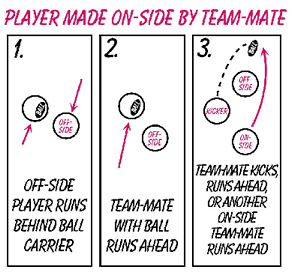
PLAYER MADE ON-SIDE BY TEAM-MATE

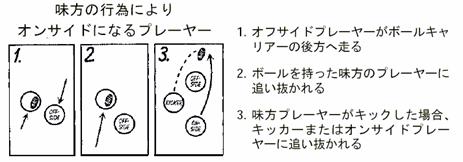
2 味方の行為によりオンサイドになる場合

一般のプレーにおいて、オフサイドにあるプレーヤーが、自らのまたは味方の行為によりオンサイドになるには次の3つの方法がある。

(a)プレーヤー自身の行為

最後にボールをキック、または、ボールに触れ、または味方のボールキャリアーの後方に自ら走ったとき、そのプレーヤーはオンサイドになる。

(b)ボールキャリアーの行為

味方のプレーヤーがボールを持って自分より前方へ走り出たとき、そのプレーヤーはオンサイドとなる。

(c)キッカーまたは他のオンサイドプレーヤーの行為ボールをキックした時(またはその後)のキッカーのいた地点、またはその後方にいた味方のプレーヤーか、またはキッカーが、オフサイドプレーヤーの前方に走り出たとき、そのプレーヤーはオンサイドとなる。

味方のプレーヤーは、前方へ走るとき、タッチまたはタッチインゴールにいてもよいが、前方にある

オフサイドプレーヤーをオンサイドにするためには、競技区域にいなくてはならない。
 

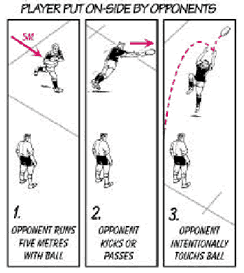
11.3 BEING PUT ON-SIDE BY OPPONENTS

In general play, there are three ways by which an off-side player can be put on-side by an action of the opposing team. These three ways do not apply to a player who is offside under the 10-Metre Law.

(a) Runs 5 metres with ball. When an opponent carrying the ball runs 5 metres, the off-side player is put on-side.

(b) Kicks or passes. When an opponent kicks or passes the ball, the offside player is put on-side.

(c) Intentionally touches ball. When an opponent intentionally touches the ball but does not catch it, the off-side player is put on-side.


PLAYER PUT ON-SIDE BY OPPONENTS
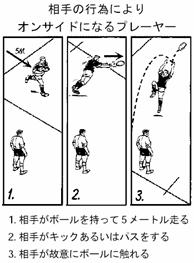
3 相手側の行為によりオンサイドになる場合

一般のプレーにおいて、オフサイドにあるプレーヤーが相手側の行為によりオンサイドとなるには次の3つの方法がある。ただし、10メートル規則によりオフサイドとなるプレーヤーには適用されない。

(a)ボールを持って5メートル走ること

相手側のボールキャリアーが5メートル走ったとき、そのオフサ ドにあるプレーヤーはオンサイドとなる。

(b)キックまたはパス

相手側のプレーヤーが、ボールをキックまたはパスしたとき、そのオフサイドにあるプレーヤーはオンサイドとなる。

(c)故意にボールに触れること

相手側のプレーヤーが故意にボールに触れ、しかもそのボールを受け損なったとき、そのオフサイドにあるプレーヤーはオンサイドとなる。
11.4 OFF-SIDE UNDER THE 10-METRE LAW

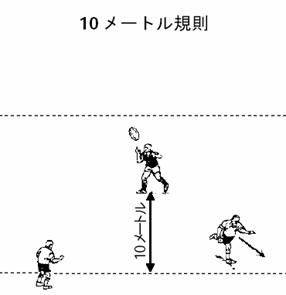
(a) When a team-mate of an off-side player has kicked ahead, the off-side player is considered to be taking part in the game if the player is in front of an imaginary line across the field which is 10 metres from the opponent waiting to play the ball, or from where the ball lands or may land. The off-side player must immediately move behind the imaginary 10-metre line. While moving away, the player must not obstruct an opponent.

Penalty: Penalty Kick

(b) While moving away, the off-side player cannot be put on-side by any action of the opposing team. However, before the player has moved the full 10 metres, the player can be put on-side by any on-side team-mate who runs in front of the player.

(c) When a player who is off-side under the 10-Metre Law charges an opponent waiting to catch the ball, the referee blows the whistle at once and the off-side player is penalised. Delay may prove dangerous to the opponent.

Penalty: Penalty Kick

(d) When a player who is off-side under the 10-Metre Law plays the ball which has been misfielded by an opponent, the off-side player is penalised.

Penalty: Penalty Kick

(e) The 10-Metre Law is not altered by the fact that the ball has hit a goal post or a crossbar. What matters is where the ball lands. An off-side player must not be in front of the imaginary 10-metre line across the field.

Penalty: Penalty Kick

(f) The 10-Metre Law does not apply when a player kicks the ball, and an opponent charges down the kick, and a team-mate of the kicker who was in front of the imaginary 10-metre line across the field then plays the ball.

The opponent was not 'waiting to play the ball' and the team-mate is onside.

Penalty: When a player is penalised for being off-side in general play, the opposing team chooses either a penalty kick at the place of infringement or a scrum at the place where the offending team last played the ball. If it was last played in that team’s in-goal, the scrum is formed 5 metres from the goal-line in line with where it was played.

(g) If more than one player is off-side and moving forward after a team-mate has kicked ahead, the place of infringement is the position of the off-side player closest to an opponent waiting for the ball, or closest to where the ball lands.

4 10 メートル規則によるオフサイド

(a)味方のプレーヤーが前方へキックしたとき、前方にいるオフサイドプレーヤーは、ボールをプレーしようと待っている相手側、またはボールが地面に着くもしくは着くと予想される地点から10メートル離れた、ゴールラインに平行な想定されたラインより前方にいる場合には、試合に参加しているものと見なされる。

このオフサイドプレーヤーは、この想定された10メートルラインの後方まで直ちに移動しなければならない。また、移動中に、相手側プレーヤーを妨害してはならない。

(b)このオフサイドプレーヤーは、移動中、相手側のいかなる行為によってもオンサイドにならない。しかし、完全に10メートル移動する前でも、味方のオンサイドプレーヤーがこのオフサイドプレーヤーの前方へ走り出た時にはオンサイドとなる。

(c)10メートル規則によりオフサイドのプレーヤーが、ボールを受けようとしている相手側プレーヤーをチャージするときは、レフリーは、直ちに笛を吹いて罰を科さなければならない。ちゅうちょするときは、相手側のプレーヤーに危険をおよぼす。

(d)10メートル規則によりオフサイドのプレーヤーが、相手側のプレーヤーが受け損じたボールをプレーしたときは、ペナルティキックを科す。

(e)10メートル規則は、ボールがゴールポストまたはクロスバーに当った場合にも適用する。問題は、ボールの着地点である。オフサイドにあるプレーヤーは、想定された10 メートルラインの前方にいてはならない。

(f)プレーヤーがキックしたボールを、相手側のプレーヤーがチャージダウンした直後に、想定された10メートルラインの前方にいたキックした側の他のプレーヤーが、そのボールをプレーした場合には、10メートル規則は適用されない。この場合チャージダウンしたプレーヤーはボールをプレーしようと待っていたことにはならないから、キックした側のオフサイドにあったプレーヤーはオンサイドとなる。

罰 一般のプレーにおけるオフサイドに対して、相手側は、反則の地点でのペナルティキック、または反則した側が最後にボールをプレーした地点においてのスクラムかのいずれかを選択する。最後にボールをプレーした地点が反則した側のインゴールのとき、スクラムが選択された場合の地点は、その最後のプレーの地点に相対する、ゴールラインから5メートルの地点。

(g)味方のプレーヤーが前方へキックしたとき、前方にいるオフサイドプレーヤーが複数、前方へ動いた場合、反則の地点は、ボールを待っているプレーヤーまたはボールが地面に着く地点に最も近いオフサイドプレーヤーの位置とする。
11.5 BEING PUT ON-SIDE UNDER THE 10-METRE LAW

(a) The off-side player must retire behind the imaginary 10-metre line across the field, otherwise the player is liable to be penalised.

 (b) While retiring, the player can be put on-side before moving behind the imaginary 10-metre line by any of the three actions of the player’s team listed above in 11.2. However, the player cannot be put on-side by any action of the opposing team.

5 10メートル規則によるオフサイドプレーヤーがオンサイドになる場合

(a)オフサイドプレーヤーは、想定された10メートルラインの後方まで後退しなければならない。後退しない場合には、反則を適用される。

(b)このオフサイドプレーヤーは、完全に10メートル後退する前でも、本条2で述べた味方の3つの行為のいずれかでオンサイドとなりうる。しかし、このオフサイドプレーヤーは、相手側のいかなる行為によってもオンサイドにはならない。

11.6 ACCIDENTAL OFF-SIDE

(a) When an off-side player cannot avoid being touched by the ball or by a team-mate carrying it, the player is accidentally off-side. If the player’s team gains no advantage from this, play continues. If the player’s team gains an advantage, a scrum is formed with the opposing team throwing in the ball.

(b) When a player hands the ball to a team-mate in front of the first player, the receiver is off-side. Unless the receiver is considered to be intentionally off-side (in which case a penalty kick is awarded), the receiver is accidentally off-side and a scrum is formed with the opposing team throwing in the ball.

6 偶然のオフサイド

(a)オフサイドにあるプレーヤーが、やむなくボールまたはボールキャリアーに触れた場合は、偶然のオフサイドである。そのプレーヤー側が利益を得なければプレーは続行する。そのプレーヤー側が利益を得た場合は、スクラムを組み相手側が投入する。

(b)プレーヤーが前方にいる味方のプレーヤーにボールを手渡した場合には、ボールを受けたプレーヤーはオフサイドである。その行為が故意である場合にはペナルティキックを科し、故意でない場合は偶然のオフサイドと見なし、スクラムを組み相手側がを投入する。

11.7 OFF-SIDE AFTER A KNOCK-ON

When a player knocks-on and an off-side team-mate next plays the ball, the off-side player is liable to penalty if playing the ball prevented an opponent from gaining an advantage.

Penalty: Penalty Kick

7 ノックオン後のオフサイド

プレーヤーがノックオンしたボールを、オフサイドの位置にある味方のプレーヤーがプレーしたとき、そのプレーで相手側から利益を奪った場合にはオフサイドの罰を科す。

罰 ペナルティキック

11.8 OFF-SIDE AT SCRUM, RUCK, MAUL OR LINE-OUT

At a scrum, ruck, maul or line-out, a player is off-side if the player is in front of the off-side line as described in the relevant parts of those Laws.

8 スクラム、ラック、モール、またはラインアウトにおけるオフサイド

スクラム、ラック、モール、またはラインアウトでは、各関連条項にて規定されたオフサイドラインより前方にいるプレーヤーはオフサイドとなる。

11.9 PUTTING ON-SIDE A PLAYER RETIRING DURING A RUCK, MAUL, SCRUM OR LINE-OUT

When a ruck, maul, scrum or line-out forms, a player who is off-side and is retiring as required by Law remains off-side even when the opposing team wins possession and the ruck, maul, scrum or line-out has ended.

The player is put on-side by retiring behind the applicable off-side line.

No other action of the off-side player and no action of that player's teammates can put the off-side player on-side.

If the player remains off-side the player can be put on-side only by the action of the opposing team. There are two such actions:

Opponent runs 5 meters with ball. When an opponent carrying the ball has run 5 meters, the off-side player is put on-side. An off-side player is not put on-side when an opponent passes the ball. Even if the opponents pass the ball several times, their action does not put the off-side player on-side.

Opponent kicks. When an opponent kicks the ball, the off-side player is put on-side.

9 ラック、モール、スクラム、またはラインアウトにおいて後退しつつあるプレーヤーがオンサイドになる場合

ラック、モール、スクラム、またはラインアウトを形成しているとき、競技規則に従い後退しつつあるオフサイドプレーヤーは、相手側がボールを獲得して、ラック、モール、スクラム、またはラインアウトが終了しても、オンサイドとはならない。このプレーヤーは自らに適用されるオフサイドラインの後方に退くまではオンサイドとはならない。オフサイドプレーヤーは、それ以外のいかなる自らの行為によっても、また味方のいかなる行為によってもオンサイドとはならない。

オフサイドの位置にとどまっているプレーヤーがオンサイドになるのは、相手側の次の2つの行為によるしかない。

・ 相手側プレーヤーがボールを持って5メートル走ったとき

相手側プレーヤーがボールを持って5メートルたとき、このオフサイドプレーヤーはオンサイドとなる。相手側プレーヤーがボールをパスしても、このオフサイドプレーヤーはオンサイドとはならない。

パスを数回してもオンサイドとはならない。

・ 相手側プレーヤーのキック

相手側のプレーヤーがキックしたとき、このオフサイドプレーヤーはオンサイドとなる。

11.10 LOITERING

A player who remains in an off-side position is loitering. A loiterer who prevents the opposing team from playing the ball as they wish is taking part in the game, and is penalised. The referee makes sure that the loiterer does not benefit from being put on-side by the opposing team’s action.

Penalty: Penalty Kick

10 うろうろすること

「うろうろしているプレーヤー」とは、オフサイドの位置にとどまるプレーヤーのことである。相手側がボールを自由にプレーするのを妨げることは、競技に参加していることであり、罰を科す。レフリーは、「うろうろしているプレーヤー」が相手側の行為によりオンサイドとなる利益を得ることがないように注意する。

罰 ペナルティキック


LAW 11 ? OFF-SIDE AND ON-SIDE IN GENERAL PLAY

第11条 一般のプレーにおけるオフサイドとオンサイド

DEFINITION

At the start of a game all players are on-side. As the match progresses players may find themselves in an off-side position. Such players are then liable to be penalized until they become on-side again.

In general play a player is off-side if the player is in front of a team-mate who is carrying the ball, or in front of a team-mate who last played the ball.

Off-side means that a player is temporarily out of the game. Such players are liable to be penalized if they take part in the game.

In general play, a player can be put on-side either by an action of a team-mate or by an action of an opponent. However, the off-side player cannot be put onside if the off-side player interferes with play; or moves forward, towards the ball, or fails to move 10 metres away from the place where the ball lands.

定 義

試合の開始時にはプレーヤーはすべてオンサイドである。試合が進むにつれて、オフサイドの位置となることがある。そのようなプレーヤーは再びオンサイドとなるまでに、競技に参加すれば反則が適用される。

一般のプレーでは、プレーヤーがボールを持っているかまたはプレーした場合に、そのプレーヤーの前方にいる味方のプレーヤーはオフサイドである。

オフサイドとは、プレーヤーが一時的にプレーできないことを意味し、かつ競技に参加すれば反則が適用される位置にあることをいう。

一般のプレーでは、味方の行為か相手側の行為かのいずれかによりオンサイドとなりうる。しかし、もしそのオフサイドプレーヤーがプレーを妨げたり、前方に、ボールの方へ動いたり、またはキックされたボールの着地点から10 メートル後方へ離れなければ、オンサイドとはならない。

11.1 OFF-SIDE IN GENERAL PLAY

(a) A player who is in an off-side position is liable to penalty only if the player does one of three things: Interferes with play or, Moves forward, towards the ball or Fails to comply with the 10-Metre Law (Law 11.4).

A player who is in an off-side position is not automatically penalised.

A player who receives an intentional throw-forward is not off-side.

A player can be off-side in the in-goal.

(b) Off-side and interfering with play. A player who is off-side must not take part in the game. This means the player must not play the ball or obstruct an opponent.

(c) Off-side and moving forward. When a team-mate of an off-side player has kicked ahead, the off-side player must not move towards opponents who are waiting to play the ball, or move towards the place where the ball lands, until the player has been put on-side.

1 一般のプレーにおけるオフサイド

(a)オフサイドの位置にいるプレーヤーが、反則となるのは次の3つのうちのいずれかを犯した場合のみである。

・プレーを妨げる、あるいは

・前方にボールの方へ動く、あるいは、

・本条4の「10 メートル規則」を守らない

プレーヤーは、オフサイドの位置にいるからといって自動的に反則となるのではない。

故意でないスローフォワードを受けとった場合、そのプレーヤーはオフサイドではない。

プレーヤーはインゴールでもオフサイドとなる。

(b)プレーの妨害

オフサイドの位置にいるプレーヤーは競技に参加してはならない。すなわち、ボールをプレーしたり、相手側を妨害してはならない。

(c)前方へ動くこと

味方のプレーヤーが前方へキックしたとき、前方にいるオフサイドプレーヤーは、オンサイドになるまでは、ボールをプレーしようと待っている相手側のプレーヤーまたはボールが地面に着く地点に近づいてはならない。

11.2 BEING PUT ON-SIDE BY THE ACTION OF A TEAM-MATE

In general play, there are four ways by which an off-side player can be put on-side by actions of that player or of team-mates;

(a) Action by the player. When the off-side player runs behind the team-mate who last kicked, touched or carried the ball, the player is put on-side.

(b) Action by the ball-carrier. When a team-mate carrying the ball runs in front of the off-side player, that player is put on-side.

(c) Action by the kicker or other on-side player. When the kicker, or team-mate who was level with or behind the kicker when (or after) the ball was kicked, runs in front of the off-side player, the player is put onside.

(d) When running forward, the team-mate may be in touch or in touch-ingoal, but that team-mate must return to the playing area to put the other player on-side.

PLAYER MADE ON-SIDE BY TEAM-MATE

2 味方の行為によりオンサイドになる場合

一般のプレーにおいて、オフサイドにあるプレーヤーが、自らのまたは味方の行為によりオンサイドになるには次の3つの方法がある。

(a)プレーヤー自身の行為

最後にボールをキック、または、ボールに触れ、または味方のボールキャリアーの後方に自ら走ったとき、そのプレーヤーはオンサイドになる。

(b)ボールキャリアーの行為

味方のプレーヤーがボールを持って自分より前方へ走り出たとき、そのプレーヤーはオンサイドとなる。

(c)キッカーまたは他のオンサイドプレーヤーの行為ボールをキックした時(またはその後)のキッカーのいた地点、またはその後方にいた味方のプレーヤーか、またはキッカーが、オフサイドプレーヤーの前方に走り出たとき、そのプレーヤーはオンサイドとなる。

味方のプレーヤーは、前方へ走るとき、タッチまたはタッチインゴールにいてもよいが、前方にある

オフサイドプレーヤーをオンサイドにするためには、競技区域にいなくてはならない。

11.3 BEING PUT ON-SIDE BY OPPONENTS

In general play, there are three ways by which an off-side player can be put on-side by an action of the opposing team. These three ways do not apply to a player who is offside under the 10-Metre Law.

(a) Runs 5 metres with ball. When an opponent carrying the ball runs 5 metres, the off-side player is put on-side.

(b) Kicks or passes. When an opponent kicks or passes the ball, the offside player is put on-side.

(c) Intentionally touches ball. When an opponent intentionally touches the ball but does not catch it, the off-side player is put on-side.


PLAYER PUT ON-SIDE BY OPPONENTS

3 相手側の行為によりオンサイドになる場合

一般のプレーにおいて、オフサイドにあるプレーヤーが相手側の行為によりオンサイドとなるには次の3つの方法がある。ただし、10メートル規則によりオフサイドとなるプレーヤーには適用されない。

(a)ボールを持って5メートル走ること

相手側のボールキャリアーが5メートル走ったとき、そのオフサ ドにあるプレーヤーはオンサイドとなる。

(b)キックまたはパス

相手側のプレーヤーが、ボールをキックまたはパスしたとき、そのオフサイドにあるプレーヤーはオンサイドとなる。

(c)故意にボールに触れること

相手側のプレーヤーが故意にボールに触れ、しかもそのボールを受け損なったとき、そのオフサイドにあるプレーヤーはオンサイドとなる。

11.4 OFF-SIDE UNDER THE 10-METRE LAW

(a) When a team-mate of an off-side player has kicked ahead, the off-side player is considered to be taking part in the game if the player is in front of an imaginary line across the field which is 10 metres from the opponent waiting to play the ball, or from where the ball lands or may land. The off-side player must immediately move behind the imaginary 10-metre line. While moving away, the player must not obstruct an opponent.

Penalty: Penalty Kick

(b) While moving away, the off-side player cannot be put on-side by any action of the opposing team. However, before the player has moved the full 10 metres, the player can be put on-side by any on-side team-mate who runs in front of the player.

(c) When a player who is off-side under the 10-Metre Law charges an opponent waiting to catch the ball, the referee blows the whistle at once and the off-side player is penalised. Delay may prove dangerous to the opponent.

Penalty: Penalty Kick

(d) When a player who is off-side under the 10-Metre Law plays the ball which has been misfielded by an opponent, the off-side player is penalised.

Penalty: Penalty Kick

(e) The 10-Metre Law is not altered by the fact that the ball has hit a goal post or a crossbar. What matters is where the ball lands. An off-side player must not be in front of the imaginary 10-metre line across the field.

Penalty: Penalty Kick

(f) The 10-Metre Law does not apply when a player kicks the ball, and an opponent charges down the kick, and a team-mate of the kicker who was in front of the imaginary 10-metre line across the field then plays the ball.

The opponent was not 'waiting to play the ball' and the team-mate is onside.

Penalty: When a player is penalised for being off-side in general play, the opposing team chooses either a penalty kick at the place of infringement or a scrum at the place where the offending team last played the ball. If it was last played in that team’s in-goal, the scrum is formed 5 metres from the goal-line in line with where it was played.

(g) If more than one player is off-side and moving forward after a team-mate has kicked ahead, the place of infringement is the position of the off-side player closest to an opponent waiting for the ball, or closest to where the ball lands.

4 10 メートル規則によるオフサイド

(a)味方のプレーヤーが前方へキックしたとき、前方にいるオフサイドプレーヤーは、ボールをプレーしようと待っている相手側、またはボールが地面に着くもしくは着くと予想される地点から10メートル離れた、ゴールラインに平行な想定されたラインより前方にいる場合には、試合に参加しているものと見なされる。

このオフサイドプレーヤーは、この想定された10メートルラインの後方まで直ちに移動しなければならない。また、移動中に、相手側プレーヤーを妨害してはならない。

(b)このオフサイドプレーヤーは、移動中、相手側のいかなる行為によってもオンサイドにならない。しかし、完全に10メートル移動する前でも、味方のオンサイドプレーヤーがこのオフサイドプレーヤーの前方へ走り出た時にはオンサイドとなる。

(c)10メートル規則によりオフサイドのプレーヤーが、ボールを受けようとしている相手側プレーヤーをチャージするときは、レフリーは、直ちに笛を吹いて罰を科さなければならない。ちゅうちょするときは、相手側のプレーヤーに危険をおよぼす。

(d)10メートル規則によりオフサイドのプレーヤーが、相手側のプレーヤーが受け損じたボールをプレーしたときは、ペナルティキックを科す。

(e)10メートル規則は、ボールがゴールポストまたはクロスバーに当った場合にも適用する。問題は、ボールの着地点である。オフサイドにあるプレーヤーは、想定された10 メートルラインの前方にいてはならない。

(f)プレーヤーがキックしたボールを、相手側のプレーヤーがチャージダウンした直後に、想定された10メートルラインの前方にいたキックした側の他のプレーヤーが、そのボールをプレーした場合には、10メートル規則は適用されない。この場合チャージダウンしたプレーヤーはボールをプレーしようと待っていたことにはならないから、キックした側のオフサイドにあったプレーヤーはオンサイドとなる。

罰 一般のプレーにおけるオフサイドに対して、相手側は、反則の地点でのペナルティキック、または反則した側が最後にボールをプレーした地点においてのスクラムかのいずれかを選択する。最後にボールをプレーした地点が反則した側のインゴールのとき、スクラムが選択された場合の地点は、その最後のプレーの地点に相対する、ゴールラインから5メートルの地点。

(g)味方のプレーヤーが前方へキックしたとき、前方にいるオフサイドプレーヤーが複数、前方へ動いた場合、反則の地点は、ボールを待っているプレーヤーまたはボールが地面に着く地点に最も近いオフサイドプレーヤーの位置とする。

11.5 BEING PUT ON-SIDE UNDER THE 10-METRE LAW

(a) The off-side player must retire behind the imaginary 10-metre line across the field, otherwise the player is liable to be penalised.

 (b) While retiring, the player can be put on-side before moving behind the imaginary 10-metre line by any of the three actions of the player’s team listed above in 11.2. However, the player cannot be put on-side by any action of the opposing team.

5 10メートル規則によるオフサイドプレーヤーがオンサイドになる場合

(a)オフサイドプレーヤーは、想定された10メートルラインの後方まで後退しなければならない。後退しない場合には、反則を適用される。

(b)このオフサイドプレーヤーは、完全に10メートル後退する前でも、本条2で述べた味方の3つの行為のいずれかでオンサイドとなりうる。しかし、このオフサイドプレーヤーは、相手側のいかなる行為によってもオンサイドにはならない。

11.6 ACCIDENTAL OFF-SIDE

(a) When an off-side player cannot avoid being touched by the ball or by a team-mate carrying it, the player is accidentally off-side. If the player’s team gains no advantage from this, play continues. If the player’s team gains an advantage, a scrum is formed with the opposing team throwing in the ball.

(b) When a player hands the ball to a team-mate in front of the first player, the receiver is off-side. Unless the receiver is considered to be intentionally off-side (in which case a penalty kick is awarded), the receiver is accidentally off-side and a scrum is formed with the opposing team throwing in the ball.

6 偶然のオフサイド

(a)オフサイドにあるプレーヤーが、やむなくボールまたはボールキャリアーに触れた場合は、偶然のオフサイドである。そのプレーヤー側が利益を得なければプレーは続行する。そのプレーヤー側が利益を得た場合は、スクラムを組み相手側が投入する。

(b)プレーヤーが前方にいる味方のプレーヤーにボールを手渡した場合には、ボールを受けたプレーヤーはオフサイドである。その行為が故意である場合にはペナルティキックを科し、故意でない場合は偶然のオフサイドと見なし、スクラムを組み相手側がを投入する。

11.7 OFF-SIDE AFTER A KNOCK-ON

When a player knocks-on and an off-side team-mate next plays the ball, the off-side player is liable to penalty if playing the ball prevented an opponent from gaining an advantage.

Penalty: Penalty Kick

7 ノックオン後のオフサイド

プレーヤーがノックオンしたボールを、オフサイドの位置にある味方のプレーヤーがプレーしたとき、そのプレーで相手側から利益を奪った場合にはオフサイドの罰を科す。

罰 ペナルティキック

11.8 OFF-SIDE AT SCRUM, RUCK, MAUL OR LINE-OUT

At a scrum, ruck, maul or line-out, a player is off-side if the player is in front of the off-side line as described in the relevant parts of those Laws.

8 スクラム、ラック、モール、またはラインアウトにおけるオフサイド

スクラム、ラック、モール、またはラインアウトでは、各関連条項にて規定されたオフサイドラインより前方にいるプレーヤーはオフサイドとなる。

11.9 PUTTING ON-SIDE A PLAYER RETIRING DURING A RUCK, MAUL, SCRUM OR LINE-OUT

When a ruck, maul, scrum or line-out forms, a player who is off-side and is retiring as required by Law remains off-side even when the opposing team wins possession and the ruck, maul, scrum or line-out has ended.

The player is put on-side by retiring behind the applicable off-side line.

No other action of the off-side player and no action of that player's teammates can put the off-side player on-side.

If the player remains off-side the player can be put on-side only by the action of the opposing team. There are two such actions:

Opponent runs 5 meters with ball. When an opponent carrying the ball has run 5 meters, the off-side player is put on-side. An off-side player is not put on-side when an opponent passes the ball. Even if the opponents pass the ball several times, their action does not put the off-side player on-side.

Opponent kicks. When an opponent kicks the ball, the off-side player is put on-side.

9 ラック、モール、スクラム、またはラインアウトにおいて後退しつつあるプレーヤーがオンサイドになる場合

ラック、モール、スクラム、またはラインアウトを形成しているとき、競技規則に従い後退しつつあるオフサイドプレーヤーは、相手側がボールを獲得して、ラック、モール、スクラム、またはラインアウトが終了しても、オンサイドとはならない。このプレーヤーは自らに適用されるオフサイドラインの後方に退くまではオンサイドとはならない。オフサイドプレーヤーは、それ以外のいかなる自らの行為によっても、また味方のいかなる行為によってもオンサイドとはならない。

オフサイドの位置にとどまっているプレーヤーがオンサイドになるのは、相手側の次の2つの行為によるしかない。

・ 相手側プレーヤーがボールを持って5メートル走ったとき

相手側プレーヤーがボールを持って5メートルたとき、このオフサイドプレーヤーはオンサイドとなる。相手側プレーヤーがボールをパスしても、このオフサイドプレーヤーはオンサイドとはならない。

パスを数回してもオンサイドとはならない。

・ 相手側プレーヤーのキック

相手側のプレーヤーがキックしたとき、このオフサイドプレーヤーはオンサイドとなる。

11.10 LOITERING

A player who remains in an off-side position is loitering. A loiterer who prevents the opposing team from playing the ball as they wish is taking part in the game, and is penalised. The referee makes sure that the loiterer does not benefit from being put on-side by the opposing team’s action.

Penalty: Penalty Kick

10 うろうろすること

「うろうろしているプレーヤー」とは、オフサイドの位置にとどまるプレーヤーのことである。相手側がボールを自由にプレーするのを妨げることは、競技に参加していることであり、罰を科す。レフリーは、「うろうろしているプレーヤー」が相手側の行為によりオンサイドとなる利益を得ることがないように注意する。

罰 ペナルティキック