LAW 20 -
SCRUM
第20条「スクラム Scrum」
DEFINITIONS
The purpose of the scrum is to restart play quickly, safely and fairly,
after a minor infringement or a stoppage.
A scrum is formed in the field of play when eight players from each
team, bound together in three rows for each team, close up with their
opponents so that the
heads of the front rows are interlocked. This creates a tunnel into
which a scrum-half throws in the ball so that front row players can compete
for possession by hooking the ball with either of their feet.
The middle line of a scrum must not be within 5 metres of the goal-line.
A scrum cannot take place within 5 metres of a touch-line.
The tunnel is the space between the two front rows.
The player of either team who throws the ball into the scrum is the
scrum-half.
The middle line is an imaginary line on the ground in the tunnel beneath
the line where the shoulders of the two front rows meet.
The middle player in each front row is the hooker.
The players on either side of the hooker are the props. The left side
props are the loose-head props. The right side props are the tight-head
props.
The two players in the second row who push on the props and the hooker
are the locks.
The outside players who bind onto the second or third row are the
flankers.
The player in the third row who usually pushes on both locks is the
No.8.
Alternatively, the No. 8 may push on a lock and a flanker.
定 義
スクラムの目的は、軽度の反則あるいは競技の停止があった後、早く、安全に、公平に試合を再開することである。
スクラムは、フィールドオブプレーにおいて、互いにバインドして3列になった8人ずつのプレーヤーによって形成され、双方のフロントローは頭を交互に組み合う。組み合うことによってトンネルが形成され、そこに、双方のフロントローが左右どちらか片方の足でフッキングすることによりボールを獲得するよう、スクラムハーフがボールを投入する。
スクラムの中央の線がゴールラインから5メートル以内にあってはならない。
スクラムはタッチラインから5メートル以内では形成されない。(理由: 明確化)
トンネルとは、双方のフロントローの間の空間をいう。
スクラムハーフとは、双方の、スクラムにボールを投入するプレーヤーをいう。
スクラムの中央の線とは、トンネル内の、双方のフロントローの肩の接点で作られた線の真下の地上に想定される線をいう。
フッカーとは、双方のフロントローの中央のプレーヤーをいう。
プロップとは、フッカーの両側のプレーヤーをいう。左側のプロップをルースヘッドプロップ、右側のプロップをタイトヘッドプロップという。
ロックとは、2列目に位置し、フッカーおよびプロップを押す2 人のプレーヤーをいう。
フランカーとは、2列目または3列目のプレーヤーとバインドし、外側に位置するプレーヤーをいう。
ナンバーエイトとは、3列目に位置し、通常は2人のロックを、場合によってはロックとフランカーを押すプレーヤーをいう。
20.1
FORMING A SCRUM
(a) Where the scrum takes place. The place for a scrum is where the infringement
or stoppage happened, or as near to it as is practicable in the field of
play, unless otherwise stated in Law.
(b) If this is less than 5 metres from a touch-line, the place for the
scrum is 5 metres from that touch-line. A scrum can take place only in the
field of play. The middle line of a scrum must not be within 5 metres of the
goalline when it is formed.
(c) If there is an infringement
or stoppage in in-goal, the place for the scrum is 5 metres from the
goal-line.
(d) The scrum is formed in line with the place of the infringement or stoppage.
(e) No delay. A team must not intentionally delay forming a scrum.
Penalty: Free Kick
(f) Number of players: eight. A scrum must have eight players from each team.
All eight players must stay bound to the scrum until it ends. Each front row
must have three players in it, no more and no less. Two locks
must form the second row.
Penalty: Penalty Kick
Exception : When a team is reduced to fewer than fifteen for any reason,
then the number of players of each team in the scrum may be similarly
reduced. Where a permitted reduction is made by one team,
there is no requirement for the other team to make a similar reduction.
However, a team must not have fewer than five players in the scrum.
Penalty: Penalty Kick
(g) Front rows coming together. First, the referee marks with a foot the
place where the scrum is to be formed. Before the two front rows come together
they must be standing not more than an arm’s length apart. The ball is in the scrum-half’s hands, ready to
be thrown in. The front rows must crouch so that when they meet, each player’s head and
shoulders are no lower than the hips. The front rows must interlock so that
no
player’s head is next to the head of a team-mate.
Penalty: Free Kick
(h) The front rows crouch and pause, and then come together only when
the referee calls ‘engage’. This call is not a command but an indication that the
front rows may come together when ready.
Penalty: Free
Kick
(i) A crouched position is the extension of the normal stance by bending
the knees sufficiently to move into the engagement without a charge.
(j) Charging. A front row must not form at a distance from its opponents
and rush against them. This is dangerous play.
Penalty: Penalty Kick
(k) Stationary and parallel. Until the ball leaves the scrum-half’s hands, the scrum
must be stationary and the middle line must be parallel to the goal-lines. A
team must not shove the scrum away from the mark before the ball is thrown
in.
Penalty: Free
Kick
1 スクラムの形成
(a)スクラムの場所
スクラムは、競技規則に他に規定がない限り、反則があった地点、競技が停止した地点、あるいはそれにできるだけ近いフィールドオブプレー内で組まなければならない。
(b)その地点がタッチラインから5メートル以内であった場合には、タッチラインから5メートルの地点で組む。スクラムは、フィールドオブプレー内でのみ形成される。スクラムの中央の線は、スクラムが形成される時点で、ゴールラインから5メートル以上離れていなければならない。
(c)インゴールで反則あるいは競技の停止があった場合、スクラムを組む地点はゴールラインから5メートルの地点とする。
(d)その場合、反則あるいは競技の停止があった地点に相対する地点でスクラムを組む。
(e)スクラムの形成を故意に遅らせてはならない。
罰 フリーキック
(f)プレーヤーの数
スクラムの形成は、双方それぞれ8人のプレーヤーによらなければならない。その8人のプレーヤーは、スクラムが終了するまで継続してバインドしていなければならない。双方のフロントローはいかなる場合でも3人のプレーヤーでなければならない。2人のロックが2列目を形成しなければならない。
罰 ペナルティキック
★例外 いかなる理由からでも、いずれかのチームの人数が15 人より少なくなった場合は、双方のチームはスクラムに参加するプレーヤーの人数を同じだけ減らしてもよい。一方のチームがスクラムに参加する人数を減らしたとき、もう一方のチームが同じ人数に合わせる必要はない。なお、いずれの場合も、少なくとも5人のプレーヤーがスクラムに参加していなければならない。
罰 ペナルティキック
(g)まず、レフリーは片足でスクラムが組まれる地点を示す。双方のフロントローは、組み合うまでは腕の長さ以内の間隔を空けておかなければならない。
スクラムハーフがボールを持ち投入できる状態になったら、双方のフロントローは、組み合ったときに頭と肩が腰より低くならないように、腰を落とした姿勢をとらなければならない。フロントローの頭は交互に組み合っていなければならない。
罰 フリーキック
(h)双方のフロントローは、腰を落とし(クラウチ)、静止し(ポーズ)、レフリーの「エンゲージ」の声があってはじめて組む。この「エンゲージ」の指示は、命令ではなく、フロントローは準備ができたら組み合ってよい、という意味の指示である。
罰 フリーキック
(i)腰を落とした姿勢とは、突進しないで踏み込んで組み合うことができるように膝を充分に曲げた姿勢をいい、正しい姿勢の一つである。
(j)フロントローが相手側とある距離を隔てて突進してスクラムを組むことは、危険なプレーである。
ペナルティキック
(k)スクラムは、ボールがスクラムハーフの手を離れるまでは、中央の線がゴールラインに平行になるように静止していなければならない。ボールが投入される前に、スクラムを押してはならない。
罰 フリーキック
20.2
FRONT-ROW PLAYERS’ POSITIONS
(a) All players in a position to shove. When a scrum has formed, the
body and feet of each front row player must be in a normal position to make a
forward shove.
Penalty: Free Kick
(b) This means that the front row players must have both feet on the
ground, with their weight firmly on at least one foot. Players must not cross
their feet, although the foot of one player may cross a team-mate’s foot. Each player’s shoulders must be
no lower than the hips.
Penalty: Free Kick
(c) Hooker in a position to hook. Until the ball is thrown in, the
hooker must be in a position to hook the ball. The hookers must have both
feet on the ground, with their weight firmly on at least one foot. A hooker’s foremost foot
must not be in front of the foremost foot of that team’s props.
Penalty: Free
Kick
2 フロントローの姿勢
(a)スクラムが形成されたら、フロントローは、前への押しが有効となるよう、足の位置と体勢を正しくとらなければならない。
罰 フリーキック
(b)フロントローは、両足を地面につけ、少なくとも片方の足にしっかりと自分の体重を乗せなければならない。他のフロントローの足と交差することはかまわないが、個々のフロントローが自らの右足と左足を交差させてはならない。また、フロントローの肩は腰より低くしてはならない。
罰 フリーキック
(c)フッカーは、ボールが投入されるまではフッキングポジションをとらなければならない。両足を地面につけ、少なくとも片方の足にしっかりと自分の体重を乗せなければならない。フッカーの前方の足は、味方両プロップの前の足より前方にあってはならない。
罰 フリーキック
20.3
BINDING IN THE SCRUM
|
DEFINITION When a player binds on a team-mate that player must
use the whole arm from hand to shoulder to grasp the team-mate’s body at or below the level of the armpit. Placing only a hand on
another player is not satisfactory binding. |
(a) Binding by all front row players. All front row players must bind
firmly and continuously from the start to the finish of the scrum.
Penalty: Penalty Kick
(b) Binding by hookers. The hooker may bind either over or under the arms
of the props. The props must not support the hooker so that the hooker has no
weight on either foot.
Penalty: Penalty Kick
(c) Binding by loose-head props. A loose-head prop must bind on the opposing
tight-head prop by placing the left arm inside the right arm of the
tight-head and gripping the tight-head prop’s jersey on the back or
side. The loose-head prop must not grip the chest, arm, sleeve or collar
of the opposition tight-head prop. The loose-head prop must not exert any
downward pressure.
Penalty: Penalty Kick
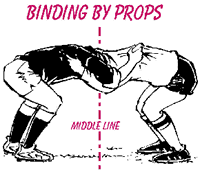
BINDING BY PROPS
(d) Binding by tight-head props. A tight-head prop must bind on the opposing
loose-head prop by placing the right arm outside the left upper arm of the
opposing loose-head prop. The tight-head prop must grip the
loose-head prop’s jersey with the right hand only on the back or side.
The tight-head prop must not grip the chest, arm, sleeve or collar of the opposition
loose-head prop. The tight-head prop must not exert any downward pressure.
Penalty: Penalty Kick
(e) Both the loose-head and tight-head props may alter their bind
providing they do so in accordance with this Law.
(f) Binding by all other players. All players in a scrum, other than
frontrow players, must bind on a lock’s body with at least one arm. The locks must bind with
the props in front of them. No player other than a prop
may hold an opponent.
Penalty: Penalty Kick
(g) Flanker obstructing opposing
scrum-half. A flanker may bind onto the scrum at any angle, provided the
flanker is properly bound. The flanker must not widen that angle and so
obstruct the opposing scrum-half
moving forward.
Penalty: Penalty Kick
(h) Scrum collapse. If a scrum collapses, the referee must blow the
whistle immediately so that players stop pushing.
(i) Player
forced upwards. If a player in a scrum is lifted in the air, or is forced
upwards out of the scrum, the referee must blow the whistle immediately so
that players stop pushing.
3 スクラムでのバインディング
|
定 義 スクラムにおいて、プレーヤーが味方のプレーヤーにバインドするときは、手から肩までの腕全体を用いて、味方のプレーヤーの胴体の、腋の高さかまたはその下の部分をつかまなくてはならない。単に味方のプレーヤーの身体に手を置いている状態は、バインドしているとはみなされない。 |
(a)すべてのフロントロー
フロントローは、スクラムが開始してから終了するまで、しっかりと、継続して、互いにバインドしていなければならない。
罰 ペナルティキック
(b)フッカー
フッカーのバインドは、プロップの腕の上からでも腕の下からでもいずれでもよい。両プロップは、フッカー自身のどちらの足にも体重がまったくかからないような状態にして支えてはならない。
罰 ペナルティキック
(c)ルースヘッドプロップ
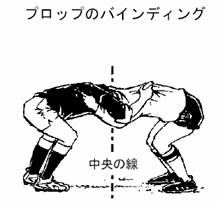
ルースヘッドプロップは、左腕を相手のタイトヘッドプロップの右腕の内側にして、タイトヘッドプロップのジャージーの背中または脇をつかみ、タイトヘッドプロップとバインドしなければならない。
ルースヘッドプロップは、相手のタイトヘッドプロップの胸、腕、袖、またはえりをつかんではならない。ルースヘッドプロップは下方へ力をかけてはならない。
罰 ペナルティキック
(d)タイトヘッドプロップ
タイトヘッドプロップは、右腕を相手のルースヘッドプロップの左上腕の外側にして、相手ルースヘッドプロップとバインドしなければならない。タイトヘッドプロップは、右手だけで相手ルースヘッドのジャージーの背中または脇をつかまなければならない。タイトヘッドプロップは、相手のルースヘッドプロップの胸、腕、袖、またはえりをつかんではならない。タイトヘッドプロップは下方へ力をかけてはならない。
罰 ペナルティキック
(e)ルースヘッドプロップおよびタイトヘッドプロップは本規定に沿っている限りはバインディングを変えても良い。
(f)他のすべてのプレーヤー
スクラムに参加しているプレーヤーは、フロントローを除き、少なくとも一方の腕を味方ロックのいずれかにバインドしなければならない。ロックは、前にいるプロップとバインドしなければならない。プロップ以外のプレーヤーは、相手をつかんではならない。
罰 ペナルティキック
(g)フランカーは、規定どおりバインドしていれば、どのような角度でスクラムにバインドしてもよいが、外側に開くことで相手のスクラムハーフがスクラムの横を前進することを妨害してはならない。
罰 ペナルティキック
(h)スクラムがくずれた場合、レフリーは直ちに笛を吹いて、プレーヤーが押し続けるのをやめさせなければならない。
(i)スクラム内のプレーヤーが宙に浮かされたり、スクラムから上方に押し出された場合、レフリーは直ちに笛を吹いて、プレーヤーが押し続けるのをやめさせなければならない。
20.4
THE TEAM THROWING THE BALL INTO THE SCRUM
(a) After an infringement, the team that did not cause the infringement throws
in the ball.
(b) Scrum after ruck. Refer to Law 16.7.
(c) Scrum after maul. Refer to Law 17.6.
(d) Scrum after any other stoppage. After any other stoppage or irregularity
not covered by Law, the team that was moving forward before the stoppage
throws in the ball. If neither team was moving forward, the attacking team
throws in the ball.
(e) When a scrum remains stationary and the ball does not emerge immediately
a further scrum is ordered at the place of the stoppage. The ball is thrown
in by the team not in possession at the time of the stoppage.
(f) When a scrum becomes stationary and does not start moving immediately,
the ball must emerge immediately. If it does not a further scrum will be
ordered. The ball is thrown in by the team not in possession at the time of
the stoppage.
(g) If a scrum collapses or lifts up into the air without penalty a
further scrum will be ordered and the team who originally threw in the ball
will throw the ball in again.
If a scrum has
to be reformed for any other reason not covered in this Law the team who
originally threw in the ball will throw the ball in again.
4 投入する側
(a)反則があったためにスクラムが組まれる場合は、反則しなかった側がボールを投入する。
(b)ラック後
ラックの後、スクラムが命じられた場合は、第16条7に従ってボールを投入する側を決める。
(c)モール後
モールの後、スクラムが命じられた場合は、第17条6に従ってボールを投入する側を決める。
(d)その他の競技の停止後
その他の競技の停止、あるいは競技規則に定めのない場合については、競技停止の直前に前進していた側がボールを投入する。どちらの側も前進していなかった場合は、攻撃側がボールを投入する。
(e)スクラムが停止したままでボールが直ちに出ない場合、停止した位置で新しいスクラムが命じられる。
停止したときにボールを保持していなかったチームがボールを投入する。
(f)スクラムが停止して直ちに再び動き始めない場合、
ボールは直ちに出さなければならない。そうでなければ、新しいスクラムが命じられる。停止したときにボールを保持していなかったチームがボールを投入する。
(g)反則ではなくスクラムが崩れるかまたは宙に浮いた場合は、再度スクラムが命じられ、最初にボールを投入した側が再びボールを投入する。
競技規則に定められのないその他の理由によってスクラムを組みなおさなければならない場合は、最初にボールを投入した側が再びボールを投入する。
20.5
THROWING THE BALL INTO THE SCRUM
(a) No Delay. As soon as the front rows have come together, the
scrum-half must throw-in the ball without delay. The scrum-half must throw-in
the ball when told to do so by the referee. The scrum-half must throw-in the ball
from the side of the scrum first chosen.
Penalty: Free Kick
(b) Intentional delay in throwing in the ball must be penalised.
Penalty: Free
Kick
5 スクラムへのボールの投入
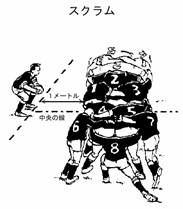
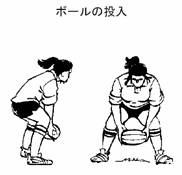
(a)スクラムハーフは、双方のフロントローが組み合うとすぐにボールを投入しなければならない。レフリーがボールを投入するよう命じた時は、直ちに、最初に選んだ側から投入しなければならない。
(b)ボールの投入を故意に遅らせてはならない。
罰 (a)・(b)フリーキック
20.6
HOW THE SCRUM-HALF THROWS IN THE BALL
(a) The scrum-half must stand one metre from the mark on the middle line
so that player’s head does not touch the scrum or go beyond the nearest front row
player.
Penalty: Free Kick
(b) The scrum-half must hold the ball with both hands, with its major
axis parallel to the ground and to the touch-line over the middle line
between the front rows, mid-way between knee and ankle.
Penalty: Free Kick
(c) The scrum-half must throw-in the ball at a quick speed. The ball
must be released from the scrum-half’s hands from outside the tunnel.
Penalty: Free Kick
(d) The scrum-half must throw-in the ball straight along the middle
line, so that it first touches the ground immediately beyond the width of the
nearer prop’s shoulders.
Penalty: Free Kick
(e) The scrum-half must throw-in the ball with a single forward
movement.
This means that there must be no backward movement with the ball.
The scrum-half must not pretend to throw the ball.
Penalty: Free
Kick
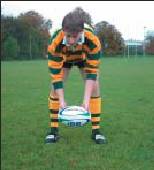
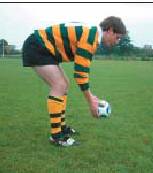
Throw-in at the scrum
6 スクラムハーフによるボール投入
スクラムハーフは次のようにしなければならない
(a)立つ位置は、中央の線上、スクラムの地点から少なくとも1 メートル離れた場所で、頭がスクラムに触れたり、一番近いフロントローを越えたりしてはならない。
(b)ボールは、膝と足首の中間の高さで、フロントローの間の中央の線上、ボールの軸が地面と、かつタッチラインと平行になるように両手で持つ。(理由: 明確化)
(c)すばやい動作で投入する。トンネルの外側でボールを手放す。
(d)中央の線に沿いまっすぐに、最も近いプロップの肩の幅を越えた地点において先ず地面に触れるよう投入する。
(e)ボールを投入するふりや、後へ引く動作をせず、前方へ単一動作で投入する。
罰 (a)から(e)フリーキック
20.7
WHEN THE SCRUM BEGINS
(a) Play in the scrum begins when the ball leaves the hands of the
scrumhalf.
(b) If the scrum-half throws in the ball and it comes out at either end
of the tunnel, the ball must be thrown in again unless a free kick or penalty
has been awarded.
(c) If the ball is not played by a front row player, and it goes
straight through the tunnel and comes out behind the foot of a far prop
without being touched, the scrum-half must throw it in again.
(d) If the
ball is played by a front row player and comes out of the tunnel, advantage
may apply.
7 スクラムの開始
(a)スクラムは、スクラムハーフの手をボールが離れたとき、開始される。
(b)投入されたボールがトンネルのどちらかの側から出たときは、フリーキックかペナルティが科される場合を除き、もう一度投入されなければならない。
(c)ボールがフロントローによって触れられることなくトンネルをまっすぐに進み、スクラムハーフから遠い方のプロップの足の後方からプレーされることなく出た場合、ボールはもう一度投入されなければならない。
(d)ボールがフロントローによって触れられた後、トンネルのいずれかの側から出た場合、アドバンテージが適用される。
20.8
FRONT-ROW PLAYERS
(a) Striking before the throw-in (‘foot up’). All front row
players must place their feet to leave a clear tunnel. Until the ball has
left the scrumhalf’s hands, they must not raise or advance a foot. They
must not do anything to stop the ball being thrown in to the scrum correctly
or touching the ground at the correct place.
Penalty: Free Kick
(b) Striking after the throw-in. Once the ball touches the ground in the
tunnel, any front row player may use either foot to try to win possession of
the ball.
Throw-in at the scrum
(c) Kicking-out. A front row player must not intentionally kick the ball
out of the tunnel in the direction from which it was thrown in.
Penalty: Free Kick
(d) If the ball is kicked out unintentionally, the same team must throw
it in again.
(e) If the ball is repeatedly kicked out, the referee must treat this as
intentional and penalise the offender.
Penalty: Penalty Kick
(f) Swinging. A front row player must not strike for the ball with both
feet.
No player may intentionally raise both feet from the ground, either when
the ball is being thrown in or afterwards.
Penalty: Penalty Kick
(g) Twisting, dipping or collapsing. Front row players must not twist or
lower their bodies, or pull opponents, or do anything that is likely to collapse
the scrum, either when the ball is being thrown in or afterwards.
Penalty: Penalty Kick
(h) Referees must penalise strictly any intentional collapsing of the
scrum.
This is dangerous play.
Penalty: Penalty Kick
(i) Lifting or forcing an opponent up. A front row player must not lift
an opponent in the air, or force an opponent upwards out of the scrum, either
when the ball is being thrown in or afterwards. This is dangerous
play.
Penalty:
Penalty Kick
8 フロントロー
(a)フロントローはすべてその足を、トンネルをはっきりと形成するように置かなければならない。ボールがスクラムハーフの手を離れるまで、フロントローは足を上げたり、前へ出してはならない。いずれのプレーヤーもボールがスクラムに投入されるのを妨げたり、ボールが正しい位置で地面に触れるのを妨げてはならない。
罰 フリーキック
(b)ボールがトンネル内の地面に触れた後は、双方のフロントローはいずれの足もボールを獲得するために使ってよい。
(c)フロントローは、ボールが入れられた方向に向って、ボールを故意にトンネルからけり出してはならない。
罰 フリーキック
(d)故意ではなく、ボールがトンネルからけり出された場合、同じチームが再びボールを入れる。
(e)ボールがくり返しけり出される場合、レフリーはそれを故意であると見なし、けり出したプレーヤーを罰しなければならない。
罰 ペナルティキック
(f)フロントローは、両足でボールをかいてはならない。ボールが投入される瞬間も、スクラムが組まれているあいだも常にプレーヤーは故意に両足を上げてはならない。
罰 ペナルティキック
(g)フロントローは、体をねじったり、低くしたり、相手を引っぱったり、あるいはその他、スクラムをくずすことにつながる行為をしてはならない。これは、単にボールが投入される瞬間に限られるものではなく、スクラムが組まれているあいだ常に適用される。
罰 ペナルティキック
(h)レフリーはスクラムを故意にくずす行為に対しては、厳格に対処しなくてはならない。これは、危険なプレーである。
罰 ペナルティキック
(i)フロントローは、相手を宙に浮かしたり、スクラムから上方に押し出したりしてはならない。これは、単にボールが投入される瞬間に限られるものではなく、スクラムが組まれているあいだ常に適用される。
これらは、危険なプレーである。
罰 ペナルティキック
20.9
SCRUM - GENERAL RESTRICTIONS
(a) All players: Collapsing. A player must not intentionally collapse a scrum.
A player must not intentionally fall or kneel in a scrum. This is dangerous
play.
Penalty: Penalty Kick
(b) All players: Handling in the scrum. Players must not handle the ball
in the scrum or pick it up with their legs.
Penalty: Penalty Kick
(c) All players: Other restrictions on winning the ball. Players must
not try to win the ball in the scrum by using any part of their body except
their foot or lower leg.
Penalty: Free Kick
(d) All players: When the ball comes out, leave it out. When the ball
has left the scrum, a player must not bring it back in to the scrum.
Penalty: Free Kick
(e) All players: No falling on the ball. A player must not fall on or
over the ball as it is coming out of the scrum.
Penalty: Penalty Kick
(f) Locks and flankers: Staying out of the tunnel. A player who is not a
front row player must not play the ball in the tunnel.
Penalty: Free Kick
(g) Scrum-half: Kicking in the scrum. A scrum-half must not kick the
ball while it is in the scrum.
Penalty: Penalty Kick
(h) Scrum-half: Dummying. A scrum-half must not take any action to make
the opponents think that the ball is out of the scrum while it is still in
the scrum.
Penalty: Free Kick
(i) Scrum-half: Holding opposing flanker. A scrum-half must not grasp an
opposing flanker in order to gain leverage, or for any other reason.
Penalty:
Penalty Kick
9 スクラムにおける、その他の制限
スクラムに参加するすべてのプレーヤー
(a)故意にスクラムをくずしてはならない。故意に倒れたり、地面に膝をついてはならない。これらは危険なプレーである。
罰 ペナルティキック
(b)スクラムの中にあるボールを手で扱ったり、脚で拾い上げてはならない。
罰 ペナルティキック
(c)足および脚の膝から下の部分以外で、スクラムの中のボールを取り込もうとしてはならない。
罰 フリーキック
(d)スクラムから出たボールをスクラムの中に戻してはならない。
罰 フリーキック
(e)スクラムから出てくるボールの上に、あるいはボールを越えて倒れ込んではならない。
罰 ペナルティキック
ロックとフランカー
(f)フロントロー以外のプレーヤーは、トンネルの中にあるボールをプレーしてはならない。
罰 フリーキック
スクラムハーフ
(g)スクラムの中にあるボールを蹴ってはならない。
罰 フリーキック
(h)ボールがスクラムの中にある間、相手にあたかもボールがスクラムから出たと思わせるような行動をしてはならない。
罰 フリーキック
(i)はずみをつけるための支えとするために、あるいは他のいかなる理由によっても相手フランカーをつかんではならない。
罰 ペナルティキック
20.10
ENDING THE SCRUM
(a) The ball comes out. When the ball comes out of the
scrum in any direction except the tunnel, the scrum ends.
(b) Scrum in the in-goal. A scrum cannot take place in
the in-goal. When the ball in a scrum is on or over the goal-line, the scrum
ends and an attacker or a defender may legally ground the ball for a try or a
touch down.
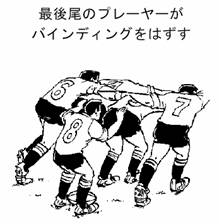
(c) Hindmost player unbinds. The hindmost player in a
scrum is the player whose feet are nearest the team’s own
goal-line. If the hindmost player unbinds from the scrum with the ball at
that player’s
feet and picks up the ball, the scrum ends.
10 スクラムの終了
(a)ボールがスクラムから出た場合
ボールが、トンネル以外のところから出たとき、スクラムは終了する。
(b)スクラムがインゴールに入った場合
スクラムは、インゴールでは形成されない。スクラムの中のボールがゴールラインに触れるか、または越えてインゴールに入った場合はスクラムは終了し、攻撃側のプレーヤーはトライすることができ、防御側のプレーヤーはタッチダウンすることができる。
(c)最後尾のプレーヤーがバインドをはずした場合
スクラムの最後尾のプレーヤーとは、スクラムに参加しているプレーヤーの中で、足が自陣のゴールラインに最も近いプレーヤーをいう。スクラムの最後尾のプレーヤーが、その足もとにボールがある状態で、バインドをはずしボールを拾い上げたとき、スクラムは終了する。
20.11
SCRUM WHEELED
(a) If a scrum is wheeled through more than 90 degrees,
so that the middle line has passed beyond a position parallel to the
touch-line, the referee must stop play and order another scrum.
EXPERIMENTAL LAW VARIATION
(b) This new scrum is formed at the place where the
previous scrum ended.
The ball is thrown in by the team not in possession at the
time of the stoppage. If neither team win possession, it is thrown in by the
team that previously threw it in.
11 スクラムのホイール
(a)スクラムが90度以上、すなわちスクラムの中央の線がタッチラインと平行になる以上に回転した場合、レフリーはプレーを止め、スクラムのやり直しを命じる。
(b)2001年度試験的競技実施規則は、2002年度も継続実施する。
この場合、スクラムのやり直しは初めのスクラムが終了した位置で行われ、ボールは、終了した時に保持していた側が入れる。どちらのチームもボールを保持していなかった場合には、初めのスクラムでボールを入れた側が入れる。
【2003年度試験的実施競技規則】
上記(b)を以下の内容に変更する。
(b)前のスクラムが終了した地点で、この新しいスクラムが命じられる。停止したときにボールを保持していなかったチームがボールを投入する。どちらのチームもボールを保持していなかった場合には、前のスクラムでボールを投入したチームが投入する。
20.12
OFF-SIDE AT THE SCRUM
|
DEFINITION At a scrum, the off-side line for the scrum-halves
runs through the line of the ball in the scrum. For every other player the
off-side line runs through the hindmost foot of that player’s team in the scrum. If the hindmost foot of a team |
(a) When the scrum is set, the scrum-half not throwing
the ball into the scrum must take up a position either at the same side of
the scrum as the scrum-half throwing in the ball or behind the off-side line
defined for other players.
(b) Off-side for scrum-halves. When a team has won the
ball in a scrum, the scrum-half of that team is off-side if both feet are in
front of the ball while it is still in the scrum. If the scrum-half has only
one foot in front of
the ball, the scrum-half is not off-side.
Penalty: Penalty Kick
is on or behind that team’s goal-line, the off-side line is the goal-line. The
offside lines are parallel to the goal-lines.
The purpose of the scrum off-side Law is to ensure
that, until the scrum ends, the team winning the ball has a clear space in
which to make use of it.
(c) When a team has won the ball in a scrum, the
scrum-half of the opposing team is off-side if that scrum-half steps in front
of the ball with either foot while the ball is still in the scrum.
Penalty: Penalty Kick
(d) The scrum-half whose team does not win possession
of the ball must not move to the opposite side of the scrum and overstep the
off-side line running through the hindmost foot of that player’s team in the
scrum.
Penalty: Penalty Kick
(e) The scrum-half whose team does not win possession
of the ball must not move away from the scrum and then remain in front of the
off-side line running through the hindmost foot of that player’s team in the
scrum.
Penalty: Penalty Kick
(f) Any player may be scrum-half, but a team can have
only one scrum-half at each scrum.
Penalty: Penalty Kick on the off-side line
(g) Off-side for players not in the scrum. Players who
are not in the scrum, and who are not the team’s scrum-half, are off-side if they remain
in front of their off-side line or overstep the
off-side line.
Penalty: Penalty Kick on the off-side line
(h) Loitering. When a scrum is forming, players not
taking part in it must retire to their off-side line without delay. If they
do not, they are loitering.
Loiterers must be penalised.
Penalty: Penalty Kick on the off-side line.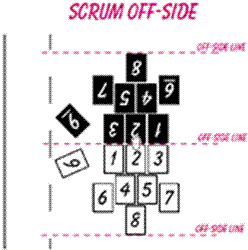
SCRUM OFF-SIDE
12 スクラムにおけるオフサイド
|
定 義 スクラムハーフにとってのオフサイドラインは、スクラム内のボールを通る線である。その他のすべてのプレーヤーにとってのオフサイドラインは、スクラムに参加している味方の最後尾のプレーヤーの足を通る線である。最後尾のプレーヤーの足が自陣のゴールライン上または後ろにある場合、ゴールラインがオフサイドラインである。 これらのオフサイドラインは、ゴールラインに平行である。 スクラムにおけるオフサイド規定の目的は、ボールを獲得したチームに、スクラムが組まれている間、ボールを活かすための明確なスペースを確保することにある。 |
スクラムハーフのオフサイド
(a)スクラムが組まれるとき、スクラムにボールを投入しない側のスクラムハーフの立つべき位置は、ボールを投入しようとするスクラムハーフと同じ側か、または他のプレーヤーに規定されているオフサイドラインの後方である。
(b)ボールを獲得した側のスクラムハーフは、ボールがスクラムの中にある間、両足をボールより前に出した場合にはオフサイドとなる。片足のみボールより前に出した場合にはオフサイドにならない。
(c)ボールを獲得しなかった側のスクラムハーフは、ボールがスクラムの中にある間、片足でもボールより前に出した場合にはオフサイドとなる。
(d)ボールを獲得しなかった側のスクラムハーフが、ボールが入れられる反対側に動いて、味方の最後尾のプレーヤーの足の線を通るオフサイドラインを踏み越えた場合はオフサイドとなる。
(e)ボールを獲得しなかった側のスクラムハーフが、スクラムから離れた位置に動いて、味方の最後尾のプレーヤーの足の線を通るオフサイドラインの前方にいる場合はオフサイドとなる。
(f)双方いずれのプレーヤーも、スクラムにおいてスクラムハーフとなることができるが、それぞれのスクラムについて1人のスクラムハーフしか置くことができない。
罰 (a)から(e)オフサイドライン上でペナルティキック
スクラムに参加していないプレーヤーのオフサイド
(g)双方の、スクラムに参加していないプレーヤーでスクラムハーフ以外のプレーヤーは、オフサイドラインの前方にとどまるか、オフサイドラインを踏み越えた場合、オフサイドとなる。
罰 オフサイドライン上でペナルティキック
(h)スクラムが形成されているとき、スクラムに参加していないプレーヤーは直ちにオフサイドラインまで退かなければならない。うろうろするプレーヤーには、罰を科す。
罰 オフサイドライン上でペナルティキック